Asian Network of Women's Shelters
Networking to Build Asian Women's Shelters
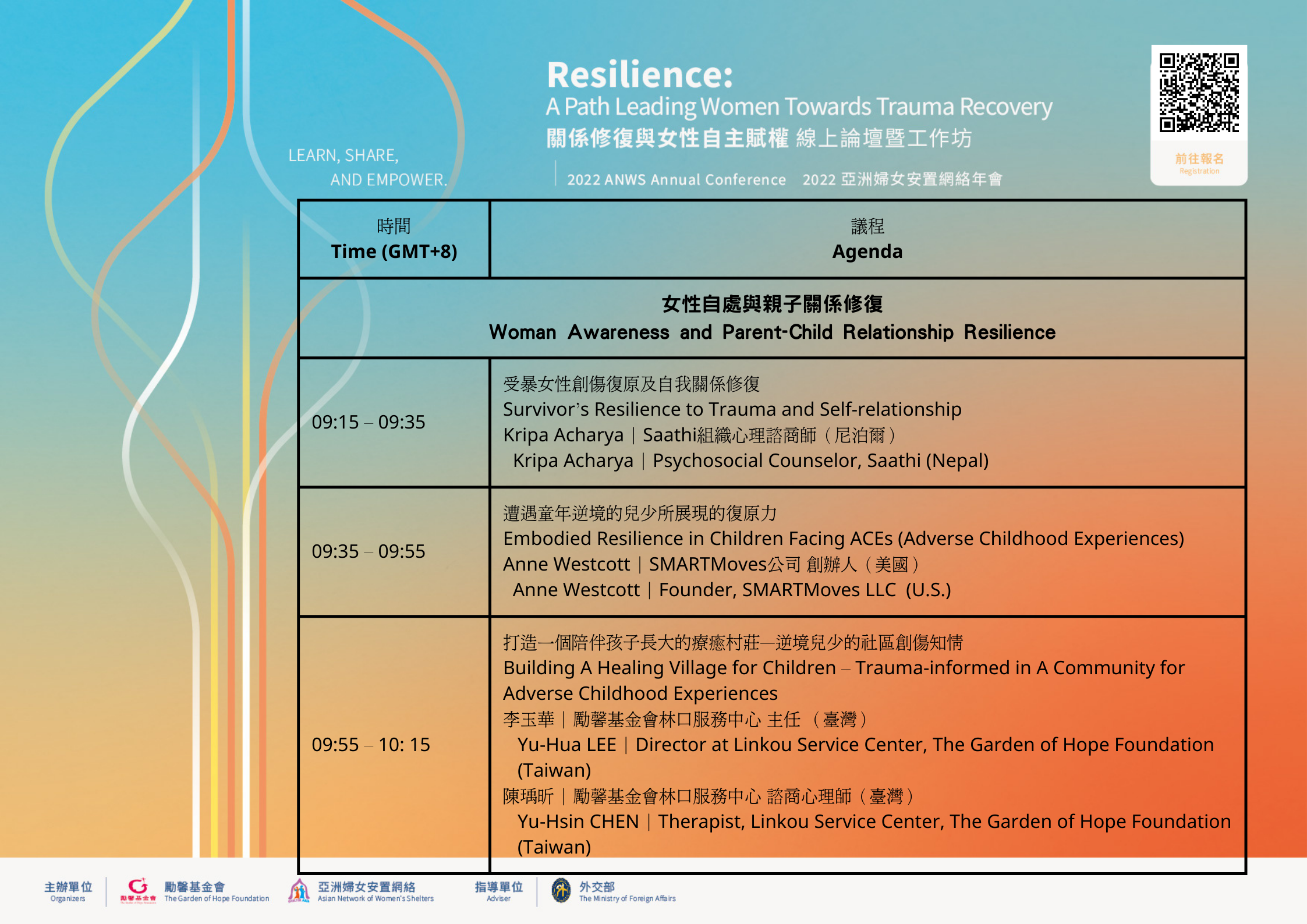
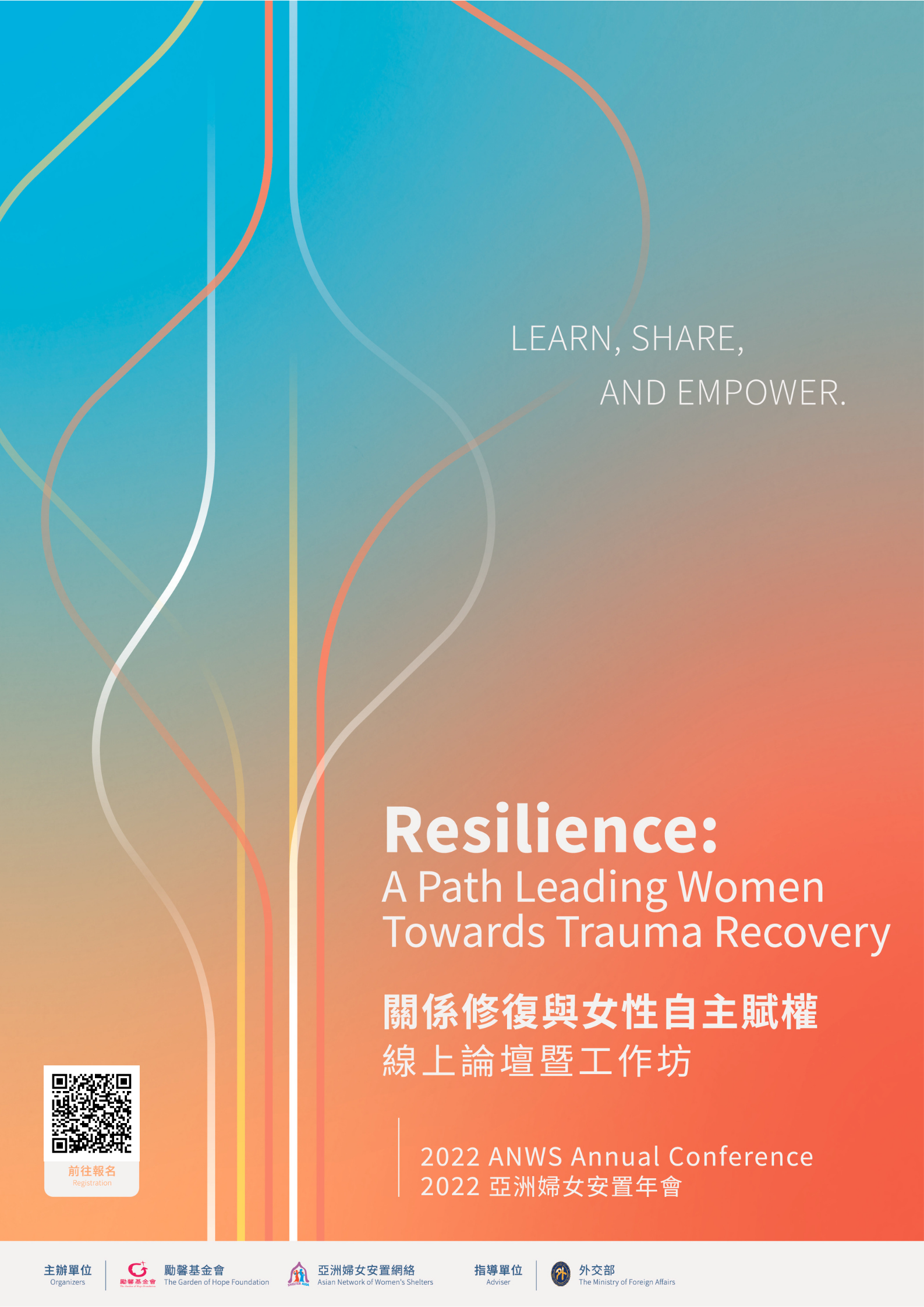
The Asian Network of Women’s Shetlers and the Garden of Hope Foundation are pleased to announce that the 2022 ANWS Annual Conference on 02 September, 2022 is now open for REGISTRATION!

We have learned trauma could affect women and children psychologically and emotionally. How we can help guide them to a path towards recovery? What role does resilience play in the recovery? How survivors can manage relationships with self, children, and perpetrators? We invite you to join this conference to hear speakers from Nepal, the U.S., Taiwan, Vietnam, Singapore, and the Netherlands sharing their insights, experiences, challenges and opportunities on relationship repair and resilience among women, children, and intimate partners.
In this conference we bring you not only keynote speeches but also workshops. We hope through this virtual conference audience can be inspired by listening and practicing sharing from speakers.
Please click here for tentative agenda.
Date: Friday 02 September, 2022
Time: 09:00 a.m. ~ 17:30 p.m. (GMT+8, Taiwan)
Platform: Zoom Webinar
Click here for your local time
Organizers
Advisor

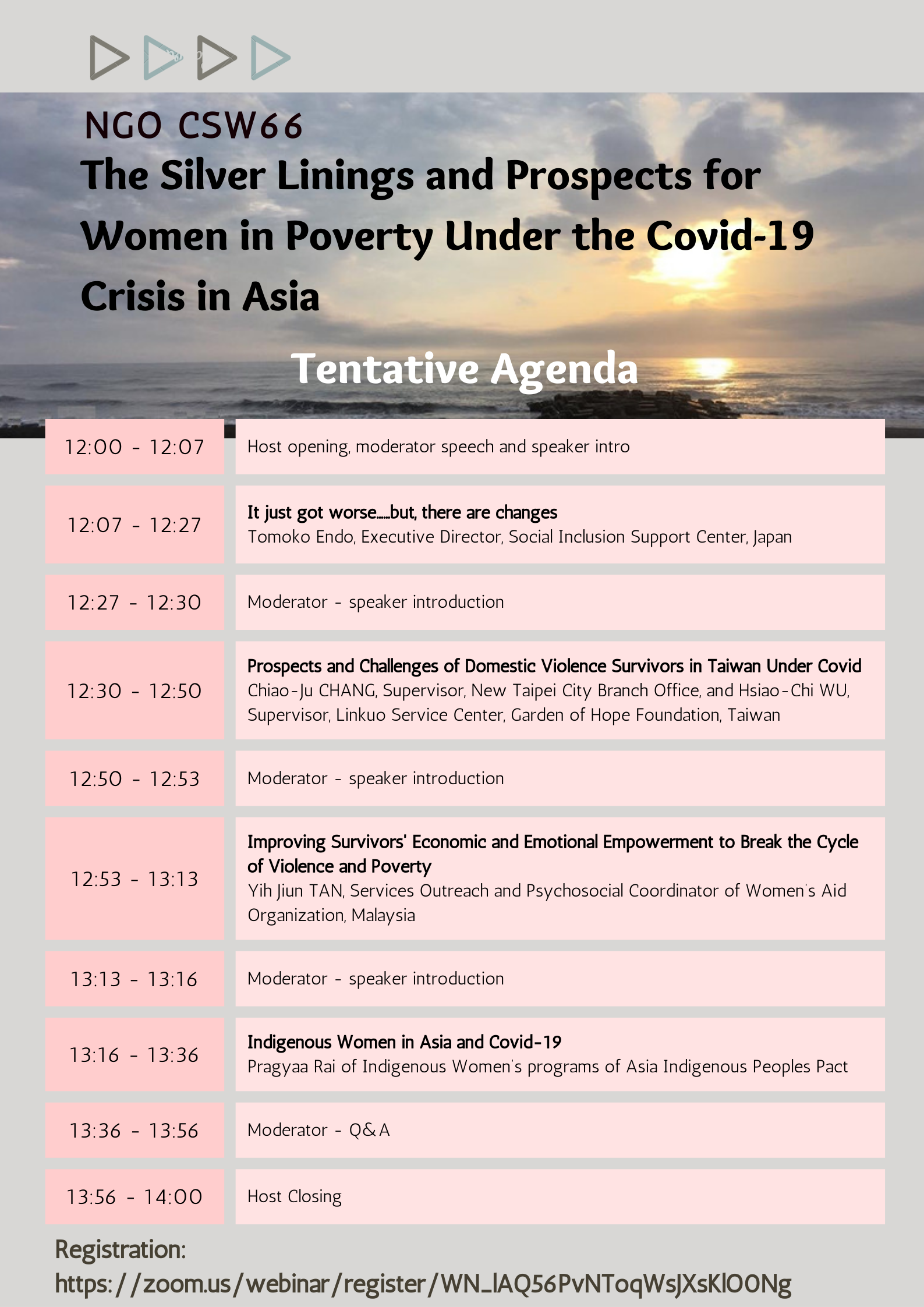
The NGO CSW66 parallel event: The Silver Linings and Prospects for Women in Poverty Under the Covid-19 Crisis in Asia jointly hosted by ANWS and the Garden of Hope Foundation (GOH) went successfully. Huge thanks and applause to our wonderful moderator and speakers from Singapore Council of Women’s Organisations (SCWO), Women’s Aid Organization (WAO) in Malaysia, GOH in Taiwan, Social Inclusion Support Center in Japan, and Asia Indigenous Peoples Pact in Thailand, and also our audience. Thank you all for making our event so successful!

If you were unable to join our NGO CSW66 parallel event, we would love to share the livestreamed recording with you. Please click at the video link below for your watching.
Please click here to download speakers’ presentation slides provided in both English and Chinese version.
Though Covid-19 pandemic makes the going get even tougher for women, but yes, we see silver linings ahead for a better change.
ANWS together with the Garden of Hope Foundation in Taiwan will hold a NGO CSW66 parallel event: The Silver Linings and Prospects for Women in Poverty Under the Covid-19 Crisis in Asia on 17 March at 12:00 a.m. ET (please click here for your local time).
As stated in UN Women’s articles women in Asia represent two thirds of the poor. Moreover, it is widely observed that GBV survivors often face economic abuse in addition to physical violence. Taking into account of their financial situations, survivors may find it hard to be independent, especially victims often have children with them to care for when they are accommodated into a shelter. How CSOs in Asia can help empower GBV survivors in economic means and access better employment opportunities is what we want to discuss in this parallel event.
Please REGISTER and join us to find out more.


Statement
November 11, 2021
In response to the tragic deaths that occurred at an immigration facility in March, we call for thorough and appropriate protection for foreign victims of domestic violence and improvement of measures.
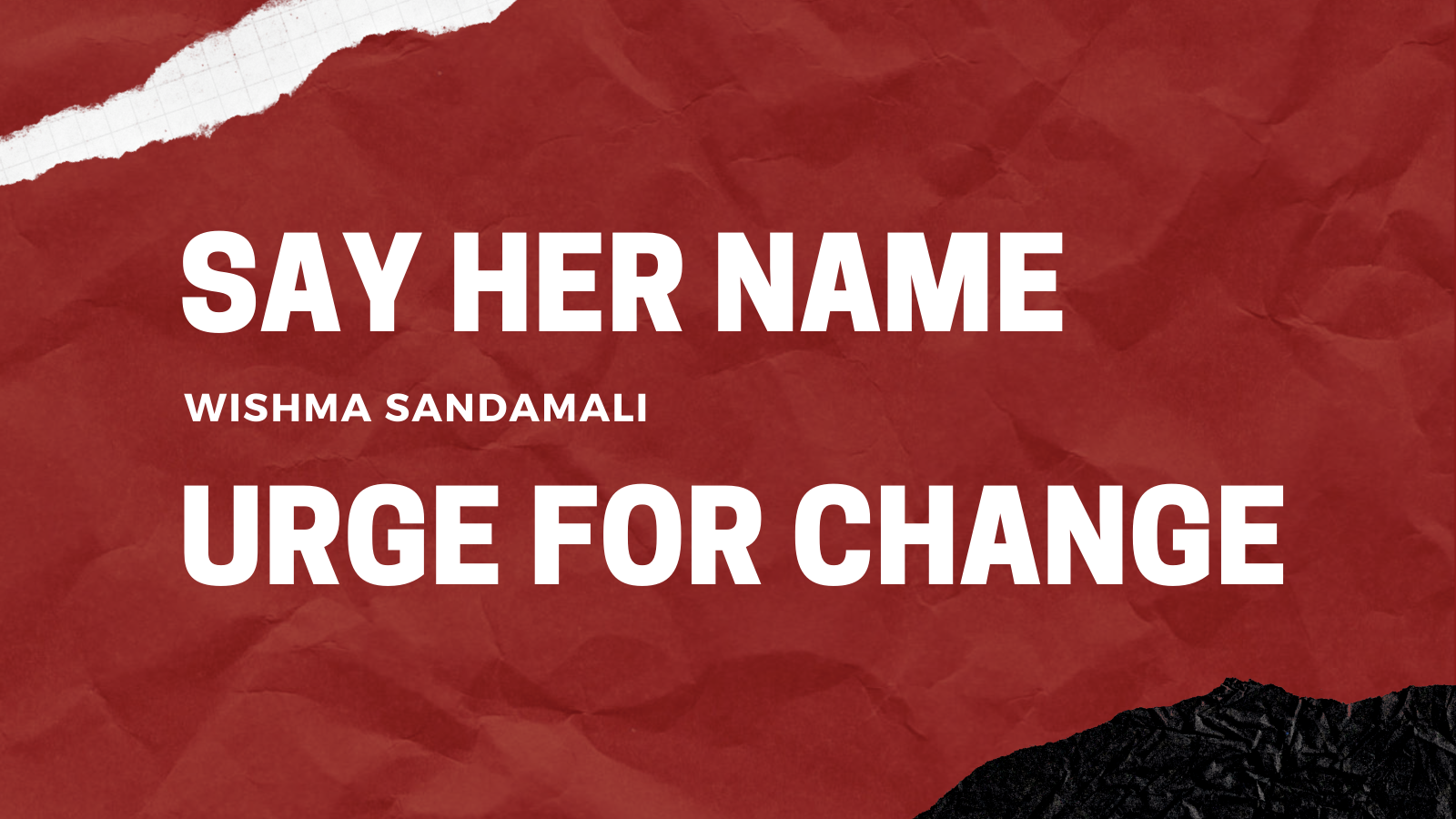
On March 6, 2021, a 33-year-old Sri Lankan woman, Ms. Ratnayake Liyanage Wishma Sandamali, lost her life in a detention facility of the Nagoya Immigration Bureau.
From the contents of the “Investigation Report on the Death of an Inmate at the Nagoya Immigration Bureau on March 6, 2021” (hereinafter referred to as the “Report”) released on August 10 by the Immigration Bureau of the Ministry of Justice (hereinafter referred to as the “Bureau”), it became clear that the Bureau’s response was inhumane and that it failed to take necessary medical measures. We strongly protest the inappropriate response of the Immigration Bureau, which took away her irreplaceable life, and we believe that it is an extremely serious problem that cannot be overlooked that Ms. Wishma Sandamali, in particular, did not receive proper protection despite her complaint of domestic violence (hereinafter sometimes referred to as “DV”) and her request for help.
Problem 1: The Nagoya Immigration Bureau’s handling of DV victims
Ms. Wishma Sandamali was detained without being protected as a victim of DV, even though she was a DV victim who consulted the police for help after suffering DV from the man she was dating. “When a victim of domestic violence or a foreign national who is considered to be a victim of domestic violence is recognized during a residence examination or deportation procedure, the foreign national should be interviewed about the details of the domestic violence case” (Article 3-1 (1)). Also, “If they wish to do so, they should contact the Spousal Violence Counseling Center or police officer in the area where they reside” (Article 5-2) according to the “Guideline for Measures Concerning Domestic Violence Cases”. However, the Bureau failed to take any action based on the DV measures, even though Ms. Wishma Sandamali had complained that she had been subjected to DV.
Problem 2: The initial response of the police
According to the Report, in the application for provisional release submitted by Ms. Wishma Sandamali on January 4, 2021, she stated that she had “appeared before the police and told them that her boyfriend had been violent” as the reason for requesting provisional release (page 57 of the report). This situation could have been prevented if the police had cooperated with the Spousal Violence Counseling and Support Center and had protected her in the shelter at a women’s counseling center, instead of the Immigration Bureau. In order to prevent a tragedy like this from happening again, the police response and the Bureau’s response should be thoroughly examined.
Problem 3: DV judgment in the Report
The Report states that the staff should have interviewed Ms. A (Ms. Wishma Sandamali) in accordance with the Guideline, but it is not clear whether Ms. A (Ms. Wishma Sandamali) would have been recognized as a victim of DV even if the staff had followed the procedure. The conclusion of the Report is extremely narrow in its view of cases in which a person should be protected as a victim of DV, and it displays nothing short of a gross lack of awareness of DV. The results of this investigation are highly reprehensible and show that if the Bureau, which has little knowledge of DV, is left to deal with DV victims, many victims will continue to be detained without being recognized as victims.

According to statistics from the Ministry of Justice, the number of DV victims recognized by local immigration offices nationwide is only in the double digits every year (82 cases in 2019). In the past, the reasons for this have been cited as the lack of support information and the inability of consultation services to respond to victims, but this case has revealed a more serious problem: the extremely poor understanding of DV at immigration offices.
Therefore, we request the following.
Part 1. To the relevant ministries and agencies:
When the police receive a consultation from a foreigner, if there is a complaint of domestic violence, regardless of whether or not the person has a status of residence, they should report it to the Spousal Violence Counseling and Support Center, not the Immigration Bureau, and ask for a response.
Part 2. Law revision
We call for the following revisions of the law:
We recognize that both the verification of this problem and the measures to prevent its recurrence are extremely inadequate, and we call for a thorough verification and the formulation of measures to prevent its recurrence, especially the prompt revision of the law and the guidelines for measures.
Solidarity Network with Migrants Japan
Japan Network Against Trafficking In Persons (JNATIP)
All Japan Women’s Shelter Network
KYOFUKAI-Japan Christian Women’s Organization
Human Rights Now
Contact to
All Japan Women’s Shelter Network office@murasaki-ribbon.sakura.ne.jp
For a complete full statement, please click the link below.
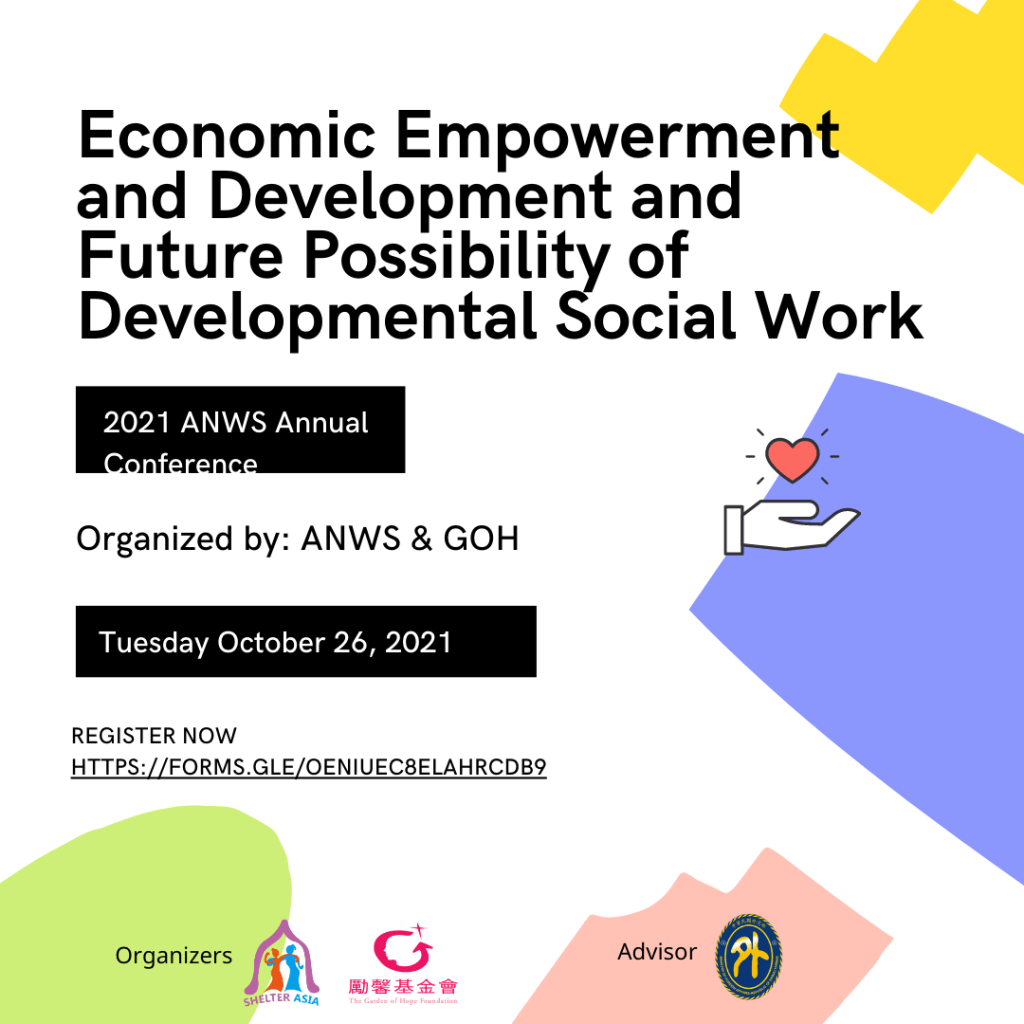
Economic Empowerment and Development and Future Possibility of Developmental Social Work
The Garden of Hope Foundation observes that poverty, deprivation, and desperation are commonly seen in many cases. It’s the priority of developmental social work to respond to these challenges. The Foundation believes that the goal of economic development and social welfare should be equally important in the empowerment process.
Developmental social work focuses on the advantage of the recipient, and pays attention to the regional characteristics. It emphasizes the process of social investment, economic policy, and public participation. It accumulates all kinds of assets (manpower, finance, and social capital) of its clienteles through a positive cycle in productive economic activity, and allows self-determination possibility and opportunity or further feedback to drive regional economic activity growth and promote overall economic development.
The conference now opens for registration! Register now: https://forms.gle/wpe26f1meqaK1Jru7

Panelists
Moderators
The Global Network of Women’s Shelters wants women and children to be safe in every country of the world. Direct help is essential for victims of domestic and sexual violence. A women’s helpline is one of the most important ways of enabling victims to find help and support.
If a woman needs help, what number do you want to give her?
Currently across the globe
Our global network unites daily experience with essential services and direct help to women and their children who are victims of domestic or sexual violence in every part of the world: we provide helplines, crisis centers, counseling and community services, shelters and rape centers. We work from a human rights and feminist perspective. We know what women need.
A global website with trustworthy and validated helpline information for victims of sexual or domestic violence is a necessary part of integrated services for women in crisis. It is also a vital referral source for supportive friends, colleagues, family members, and for professionals (including police, doctors, hospitals, legal advisors, government or embassy staff).
Currently the European Network WAVE6 has the only continent-wide vetted list of helplines on their website https://www.wave-network.org/find-help/. The GNWS proposes to build on the data already collected by the European network to avoid duplicating efforts, but to ensure that helplines for every country in the world are easy to access in a crisis. WAVE has struggled to keep the helpline information up to date and accurate with only one half-time position funded to maintain all of the helpline and NGO information for across all of Europe. This proposal includes some modest additional staffing funds to enable a full-time staff person to work across Europe to regularly update the database. It also contains some modest staffing to allow the GNWS to collect and vet helpline and NGO information from all continents.
As mentioned on the webinar, GNWS is collecting the national helpline for every country so victims and their friends and family have a place to find accurate support. Even if your country doesn’t have a national helpline, we want to know! In response to the COVID-19 pandemic, we are also asking about text, chat, and email helplines. Please take a few minutes to complete this brief form so we can continue to update our list of helplines. If you have already completed the form, thank you so much. Your information is greatly appreciated!
Form in English: https://docs.google.com/forms/d/e/1FAIpQLSc3ykdy9kjBqce58cGvFmpKv6DHiblZNnnWH6m0vmoqcAb67A/viewform
Forma en Español: https://forms.gle/X6Rw6hHM7Lo6SmC57
List of helplines listed on Facebook: https://www.facebook.com/safety/domesticviolenceresources
Previous Webinar Recordings
2 September 2020: https://www.youtube.com/watch?v=R4HUHpa2PuQ
15 July 2020: https://bit.ly/GNWSWebinar12
1 July 2020: https://youtu.be/eRGpZeXyXxI
17 June 2020: https://youtu.be/mLEICnVTMNA
3 June 2020: https://youtu.be/aymp8kklfw4
20 May 2020: https://bit.ly/GNWS_8
6 May 2020: https://youtu.be/k2h0XGANrHM
29 April 2020: https://bit.ly/GNWS_6
22 April 2020: https://bit.ly/serving_survivors
15 April 2020: https://bit.ly/GNWS_4
8 April 2020: https://bit.ly/GNWSTech
This brief 2-3 minute survey will help the GNWS develop future webinars in response to the COVID-19 pandemic and beyond. We appreciate your feedback.
https://www.surveymonkey.com/r/GNWSwebinarseval
Sign up for the GNWS Listserv
If you are not on the listserv, you can sign-up by clicking the following link: https://lists.gnws.org/lists/subscribe/announcement.
Registration for the 2020 Asian Conference of Women’s Shelters is now open! This year’s conference will take place virtually in three 90-minute webinars throughout October and November. We have a fantastic line-up of top speakers including CEDAW committee member and former GNWS chairperson Bandana Rana, UN Women AP Regional Ending VAW Programme Manager Melissa Alvarado, Thai LGBTQ activist Matcha Phornin, internationally renown journalist/author and activist Mona Eltahawy, Australian journalist and author of the groundbreaking “See What You Made Me Do” Jess Hill, and leading Singaporean lawyer Malathi Das. With the COVID-19 crisis still raging, the webinars will focus on empowering the next generation of activists and frontline shelter workers in the post-COVID age, hearing and responding to the voices of survivors, and concrete steps to end the shadow pandemic of violence against women and girls.
Please click this document for details. The webinar series is organized by the Garden of Hope Foundation and the Asian Network of Women’s Shelters, with a focus on Asian issues, but all are welcome to join. Please register separately for each webinar.

Tuesday 6 October at 16:00-17:30 Taiwan local time (GMT +8)
Gender Equality and Paving the Way for Future Generations
Speakers:
Bandana Rana, Vice Chair at UN CEDAW Committee
Melissa Alvarado, Ending Violence against Women Regional Programme Manager, UN Women
Tuesday 20 October at 16:00-17:30 Taiwan local time (GMT +8)
Testimonies from Gender-Based Violence Survivors during the COVID-19 Pandemic
Speakers:
Matcha Phornin, Founder and Executive Director of Sangsan Anakot Yawachon Development Project
Mona Eltahawy, Journalist
Tuesday November 3 at 16:00-17:30 Taiwan local time (GMT +8)
How to Systematically End Violence Against Women?
Speakers:
Jess Hill, Investigative journalist and author of SEE WHAT YOU MADE ME DO
Malathi Das, Family Lawyer and Mediator, Joyce A Tan & Partners LLC
To find out when the webinars will be held in your time zone please check here. Videos will be posted online at a later date. Feel free to share this information among your networks. Should you have any questions, do not hesitate to contact us at secretariat@shelterasia.org. webinar will be held in your time zone.