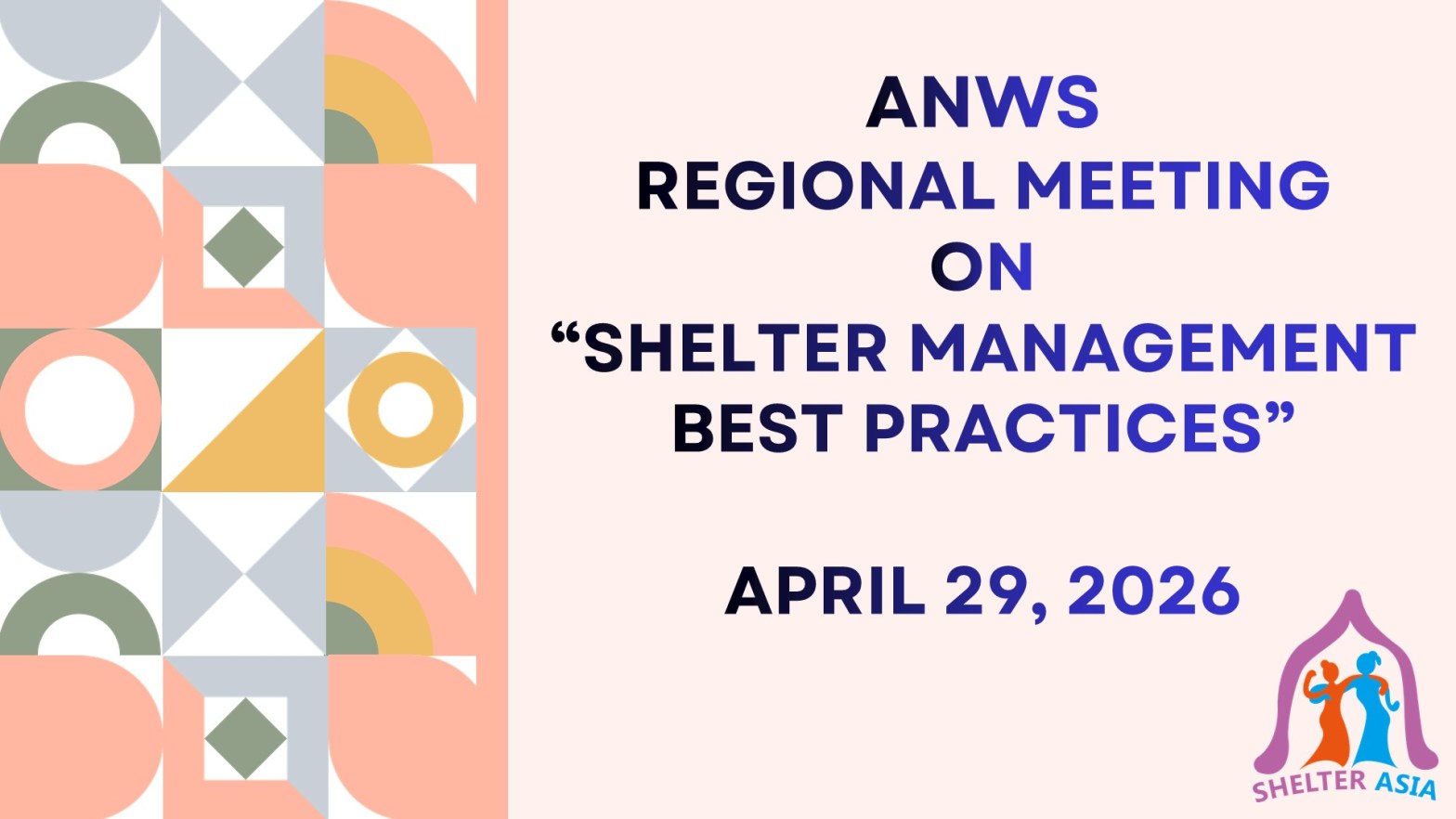
On April 29, 2026, the Asian Network of Women’s Shelters (ANWS) gathered for their second Regional Meeting of the year to discuss Shelter Management Practices, analysing regional and global gaps in the shelter system, concluding in comprehensive learnings.
A summary of the key takeaways from the meeting
Following the members feedback from the last meeting held in January the topic of this quarterly meeting was Shelter Management Best Practice, an expert-led session followed by an extensive discussion.
We are very happy to have been able to include such excellent expert presentations in our meeting and would like to take this opportunity to once again thank Dr. Prasanna Gettu (PCVC, India) and Dr. Johanna Hietamäki (Finnish Institute for Health & Welfare) for their contributions.
Our first speaker Dr. Prasanna Gettu talked about the importance of “invisible” needs, emphasizing that healing occurs through personal connection and empathy, not just infrastructure. Therefore, shelters must address the invisible emotional trauma of survivors. In the same vein, she argued that rules are necessary, but survivor-centered principles based on respect and dignity are vital to keep the system effective and human. The shelter environment and staff behavior should prioritize restoring trust, which can be achieved with just a few small changes in language and behavior. Dr. Gettu further points to a multi-generational approach where children should not just be seen as “accompanying dependentsco” but carriers of trauma. While traumatized mothers may struggle with parenting, shelters must step in and take better care of children. She concludes her presentation by affirming that survivors don’t go back because they choose violence, but because alternative support systems collapse. Success should therefore be measured by sustained recovery and livelihood planning after survivors leave the shelter.
The second speaker of the meeting was Dr. Johanna Hietamäki researching domestic violence shelters around the world. First, she introduced us to the effects of the Finnish Shelter Act ensuring public funding and standardized high quality across all shelters. This facilitates survivors in Finland to move between shelters safely. Afterwards, she offered us insights into her global research on domestic violence shelters. Despite limited data, her global research shows high variations in length of stay and post-shelter services. Asian shelters notably show a high rate of data collection regarding survivors after they leave. Regarding the shelter system in Finland, she added that it is part of the social service system, and although it is publicly funded by the state, the service providers are mainly NGOs.
After the presentations we had time for an extensive discussion session during which we exchanged views on various topics, including the professionalism of the shelter staff, ranging from regions relying mainly volunteers to staff requiring a high educational degree. Participants further discussed the challenge to apply trauma-informed care in the day-to-day support of survivors; the solution being small changes towards gentle, sensitive language and long-term trust-building. Additionally, members agreed on the importance of continuous monitoring and evaluation of shelters to ensure the safety and well-being of survivors.
In conclusion, we can take away two key learnings from this meeting for the future:
- First, post-shelter support remains the biggest “gap” globally, showcasing that long-term reintegration is more challenging than the emergency stay itself.
- Second, survivor-centered principles expressed in sensitive language and behavior build the foundation for effective, lasting support.

